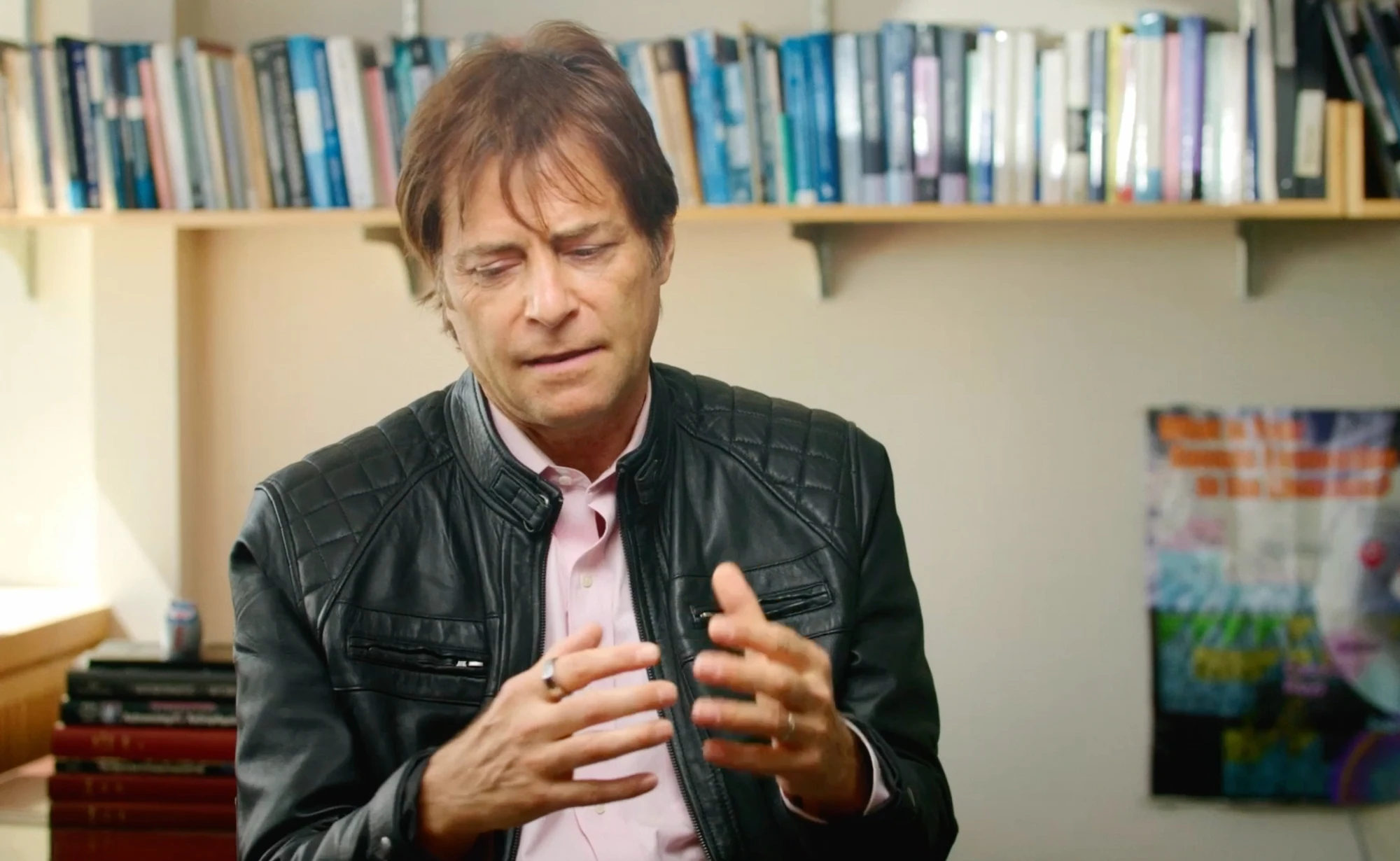
Physicist and MIT professor Max Tegmark joins Joel Hellermark for a wide-ranging exploration of AI, consciousness, and the future of humanity. Tegmark reflects on his lifelong fascination with big questions, drawing parallels between cosmology and intelligence research. He shares why current models like transformers are likely just a first step, predicts future breakthroughs by combining neural and symbolic reasoning, and discusses how AI can accelerate science and education. Tegmark highlights the need for robust safety standards, the importance of keeping humans at the center, and the potential for AI to help solve humanity’s greatest challenges—if we prepare wisely and act with care.
Watch the full episode above or read the transcript of their conversation below.
I remember when I was a teenager out on, Giulietta and Roma. Lying in a hammock between two apple trees. And I realized then that I just loved thinking about big questions and mysteries. And I always felt that, the two biggest mysteries of all were our universe out there. the universe in here. Intelligence in the mind.
And so throughout my career, I started with the outer universe and worked on that a whole bunch. And then I got too excited about artificial intelligence and neuroscience. And that's what I've been researching here at MIT for the past eight years. And, it's the crazy, exciting time. You know, just the four years ago, most of my colleagues thought that, we would decades away from something as smart as ChatGPT for because they thought we can never make machines that master language in human knowledge until we figured out how our brain works, and we're nowhere near it still.
And it turned out there was an easier way to make machines that think, well, and this reminds me a lot of, the situation with flight. But, in the year 1900, someone could have said, oh, we're never going to figure out how to make flying machines until we figured out mechanical birds. But that was completely wrong, because there was a much easier way to build machines that could fly much faster than birds, even.
And I think that's what we're seeing. the transformers that are powering our lives today are just incredibly simple compared to the brain. And that I think, we should be very humble and never be too confident that something is impossible to do soon because, there might be easier ways than we realized.
How did those ideas from cosmology influence your your AI research?
They influenced me by thinking make me always look at the book for the bigger picture. I think today, especially young people almost put an equal sign between artificial intelligence and artificial neural networks. Some even put an equal sign between AI and transformers. The particular kind of neural networks that powers. ChatGPT. I think that's way too narrow minded.
I think, transformers are going to be remembered as the vacuum tubes of AI. You know, vacuum tubes were the first technology that really let us build electronic computers, but then we found better ones, and I'm pretty confident that in not too many years, we'll have found much better AI architectures than what we have now, which let you do the same thing with what?
Much less data, much less power AI, much less electricity use.
Do you think the brain does something different than the next token or next word prediction?
For sure. Our brain, for example, is a so-called recurrent neural network where information flows around and loops. There are no loops in a transformer. And, that's very interesting actually, because one of the more detailed theories of what causes consciousness, subjective experiences of colors and sounds and love and so on is that you need the loops for it.
but, we can of course, train recurrent neural networks also. And I suspect that, the new AI architectures will end up being better than today's transformers will probably combine a few additional ingredients like this that the brain uses that, Transformers don't like. Human brains learn from often. A lot fewer examples. We need a lot less training data than the big AI systems of today.
And, you see these data centers going up using many, many millions of what's in your brain, 20W. So clearly we have we can get more ideas from the brain, but we don't have to totally understand how the brain works when, the brain was optimized by evolution, it was constrained to only develop a biological computer that could self-assemble.
And they could do it with only the most using the most common atoms in the periodic table. You know, really weird constraints and engineers just don't care about. Whereas, there was no limit on there was no need for it to be simple and easy to understand, whereas that's where we tend to be limited by US engineers.
And what what do you think. Yeah. Is this missing ingredient. So you mentioned recurrence. what do you think is required to get these models to do more, more reasoning?
I'm not going to give you a glib answer because I think I don't know and nobody knows exactly. But, if you, very crudely think of the history of AI as two stages. Stage one was to go for a good old fashioned AI where you have these symbolic logic based systems. And then stage two was the self-learning neural networks that largely crushed the old stuff.
This has made us think that, the neural networks are like the better, cooler one. But if you look in the living world of animals around us, it's kind of been the other way around. Cats and dogs and eagles have often better vision systems or olfactory systems, etc., than we do. What's special about humans is not that we can see better than an eagle, it's that we can also reason with symbols and communicate with human language and mathematical language and programing languages.
And somehow we can combine the old AI and the new I and the seamless way. And that's how I see the path to, superhuman AI going as well. But people figure out how to take these powerful new systems, merge them with, with a lot of these more symbolic techniques. And so that, in a way, a bit more like how we humans do it.
And what's really fascinating with this is the analogies that, models are able to, to, to take. So, you train a model on, code, it gets better at human language as well. And so it's able to derive some higher abstraction, which allows it to do transfer learning between two entirely different domains. which speaks to sort of, you know, how important analogies are and, analogies both for the human brain, which seems to do the majority of sort of what makes makes up how we respond.
But but equally for, for these models, what do you think of are some of the most interesting sort of analogies that you've come across when studying this models, how it's able to draw this conclusions based on derived insights from different domains?
Yeah. This is something we work a lot on in my AI research group just eight years ago, when we switched from doing physics to doing machine learning, and we sit in this very office and thought very much about this question, how do these analogies get discovered? How do machine learning systems generalize from one thing they've learned in one domain to other things?
And that we published some recent papers about it, which I find really cool. And it's all about discovering patterns which neural networks are very, very good at, feed it the massive amount of data and then that's it. Start to see patterns like, wait a minute, you know, like, for example, you, have, large language models read all the text on the internet, and then it realizes that actually all these places, it makes more sense if it chooses to represent them in a two dimensional space, a map, even if it's never seen a picture of a map.
And then we wrote a paper where we looked inside Lambda2, and there is a map sitting there, literally where Stockholm is here, and yet the body is there. And once it's realized that it can represent things like this, it can now start answering questions that it never saw in the training data. Like if you ask it, is you have the boy west of Kathmandu.
You know, it probably never saw that question, but it has a map. It's represented at this way because it to answer all the other some other questions. Right. And now yeah it can figure these things out. We see the same things when translating for example the weather. If you look at how it represents words, it puts them in a sort of high dimensional map, word embeddings.
And if you take there was a nice paper recently where someone took the word embedding of English words from reading a bunch of English text and word embeddings in Italian, from reading a bunch of different Italian texts and figured out how do you need to, like, rotate and shift these things so that they kind of match well? And they got out a pretty good English Italian dictionary just from this pattern, matching up these patterns.
So I think these AI systems should learning a lot of these geometric patterns. And that's one of the key reasons that they are often able to generalize and actually, answer a whole new questions that you have never that they've never been trained on.
Because that seems to be the with, which this models could also supersede current human knowledge, where they're able to draw this analogies between very different disciplines in a way which would have been infeasible for humans. Yeah. Maybe you're clever enough to sort of master all human knowledge, but it seems like that's quite a difficult thing to to do today.
But that this model is can not only do that, but it can even fit it into their short term memory soon with like the context. Yeah. Context windows. So what's your perspective on that in this model's ability to supersede the current, human knowledge to go way beyond it?
You know, I think it's absolutely going to happen, no doubt about that. And, I mean, if you and I could just read all the internet and everything I've written in all the languages somehow and keep this in our minds, I'm sorry, I could not. We would see a lot of patterns, too. And when I talk to the colleagues of mine who are working on training these models, they they tell me themselves, they were pretty shocked, like, oh my gosh, this thing can translate English.
The Chinese, we never taught it to do that. Oh my gosh, it can code in Python. Like how did it figure that out? And the what I think, we might be seeing a lot of in 2024 is, patterns and syntax enacting things not just in terms of the basic knowledge, but also in terms of using tools.
so right now these labs, they tend to output tokens, new word or pieces of words, but people are realizing you can also give them the option to output commands to a calculator that can do really good math, or to a dictionary, or to it, all sorts of other tools, or to a database. And this is this is something we humans, of course, do routinely.
If you're driving, you know, sending them almost becomes like an extensive extension of your body. This can this can start to overcome a lot of the intrinsic weaknesses, I think, in large language models, because we have all these old fashioned AI systems that can make very powerful tools. So if the lamb learn to use them, then, they can get the best of both worlds.
This also is very powerful for, building, robots, whether they be robots on wheels like self-driving cars or more humanoid ones where it can fundamentally, it can be controlled to some level by a large language model. Depends what some of the tokens it outputs. Just motor commands and things like that.
And what do you think is the right way of looking at this? This models because, you know, initially they were language models, but now they're increasingly multimodal. Yeah. Would you say they're sort of, compression of all the world's knowledge are the, you know, token predictors or what's the right way of, of, of viewing the current state of, of this models.
It's pretty diverse. I think it's almost easier to look at the end point of where this is going, rather than trying to classify exactly what happens right now. There's a huge commercial pressure to build systems that are agents, traditional LMS or more like an oracle. You ask the question and gives you an answer, but there's so much commercial value to have agents which will actually do stuff, take information and figure out what what actions to take to accomplish a goal, and then go out and do it.
And I think 2024 will probably also maybe be remembered as the year of the agents. When we start seeing a lot of more autonomous systems, first, purely software ones on the internet. And and then gradually we'll get more, more and more physical agents to this can of course, be great for me for many purposes, but this is obviously something we have to be careful with because if we have a lot of autonomous systems that act in the world, you know, it starts to feel less like just a new technology, like electricity and more like a new species.
Do you think that we could radically accelerate the rate at which we discover new science? And and if we do that, what could happen for the world?
It could be amazing. I mean, I really like the vision of your company to, accelerate the growth of knowledge and make it widely accessible to everybody. This is, to me, one of the coolest things in the history of life on Earth that we've gone from being so disempowered, you know, 30 year life expectancy, knowing very little about what was going on to developing science over thousands of years, becoming first, more knowledgeable about what's actually happening.
And then through this knowledge, also developing technology that put us more in charge and let us control our destiny, sort of be the captain of our own ship. So I very much applaud this. I think, if you can have AI systems that can have get very deep insights and very broad knowledge themselves, clearly that can revolutionize education.
You know, my job is not just that of a researcher, even though that's why I spend most of my time on here in this office, but also very much as an educator and, to me, the first thing I always have to do before I start teaching something is make sure I really have a deep understanding of it, much deeper than what the students need to get later.
And that lets me. And then, I mean, I need an understanding also of students. Where are they? That's also something I can get better at understanding what what the people who are trying to learn actually know already and what they don't know and what their misconceptions are. And then finally, I can tackle this question. What is the most helpful way for me, you know, to convey this knowledge?
Where do I start? What are the metaphors and analogies that are going to work? And what how should I present this so that they they keep being motivated and curious to learn more? I think I can really, help revolutionize education in the broad sense of the word. I certainly love the idea of talking to some real expert in something who's willing to give me some of their time and answer questions in a way that makes sense to me.
That's one of the great joys of working at this university. And, if, there are AI systems that will play that role also and teach me things the way I will really get it, I would love that.
One of the assumptions with, with the sort of historical reasonings has been that the are self-improving the, the current state of this model is, you know, you have to buy massive amounts of compute units to spend six months training them. they're, they're very a lot of small things that go wrong when, when when you run this, clusters.
What's your intuition there? Because they're not really self-improving now. So how can we sort of hit that escape velocity given how they're currently trend?
So I think it's a mistake to think that now over time now itself, it's not Self-improving now it's not self-improving. And all of a sudden that is and boom, the singularity. It's a gradual transition. Technology has always been self-improving. We all always use yes. Today's technology, the build, tomorrow's technology, which is why we've seen an exponential growth in productivity and technology in most measures.
but what we also see is in this exponential growth, if I look at the world's GDP over time or most measures of tech, the time it takes to get twice as good, it keeps shortening. So it's actually growing faster than exponentially. And the today you have must have a lot of people doing coding in your company.
Right. who are using autopilot of some form. I don't know if it's making them twice as productive or 1.5 times or three times as productive, but this is already an example of how AI is enabling AI development to go faster. So it is a kind of self-improving recursive self-improving, but there's still humans in the loop. it's just that over time we get less and less humans in the loop.
When we had farming before, like almost all people in Sweden were in that loop farming. Now there's like 1% in that loop. similarly, with software development, they'll gradually be fewer and fewer. If you look at a car factory today, there are way fewer people per car produced than there were 50 years ago. So I think that's how it's going to go.
We'll we'll see that, you need fewer and fewer and fewer humans in the loop at some point there'll be no you might be no human in the loop, and then things will take off even faster. But it's you're going to start noticing the approach.
Why do you have such a strong bias towards humans compared to the, AI models?
Because I am a human. I have a lovely little one year old Leo. Yeah. And when I look into his eyes, you know, I feel his most my son. I. Of course, I should feel more loyal to him than to some random machine, shouldn't I? And, I feel, We humans have figured out collectively how to start building.
I am. So I think we have the right to have some influence over what future we build. I want to seem human here and not the machine, I think. I think, I think we want to have the machines work for us, not the other way around.
I saw this awesome picture from the 2015 I safety conference that you organized. Can you tell us a bit more about who was there and what you talked about?
Oh, yeah, that was quite fun. only approaching the 10th anniversary now. So this is I like to think, being you, I felt, it was really important to start having a conversation with all the leading players on how we can make. I get used for good things rather than for bad things. And I felt the situation was totally dysfunctional in 2014 because on the one hand, you had, a small group of people who were worrying about building smarter than human AI that we would lose control over.
And then, on the other hand, there were the people actually driving the AI development in the big companies and in academia, who had never really talked to those people who were worried and felt, those are just a bunch of weirdos. Maybe we should ignore them because it could be bad for funding. So I had this vision that we should actually try to bring them together.
And, you know, one thing that Sweden is strangely good at is throwing good parties, from the Nobel Fest to the more informal ones. So I pull out all the stops to try to entice people to come to this conference, put it not in Sweden, but in Puerto Rico. In January, I sent out an invitation with a picture of a guy digging his car out from one meter of snow right next to the beach by the hotel and be like, where would you rather be in January 2015?
And, I went first after the, most high profile people I thought maybe I could actually persuade. And then when you get them, you know, you can start building a Swedish snowball all the roads down the hill and you get more. And in the end, we got, amazing people. We got Demis Hassabis, the CEO of DeepMind.
We got Elon Musk, we got really top professors from academia and also all the top people who had been working, you know, Ellie from Ellie as a good kowski to Nick Bostrom and so many others. And to make sure they didn't kill each other, we had a lot of wine and dessert pleasant, and I was really happy with how this ended up.
everybody came together and signed a statement saying, you know, yeah, the risks are real. let's, let's deal with them and, let's do research not just on how to make AI more powerful, but also on how to make it safe and transparent and controllable. Elon Musk said, okay, I'll give you 10 million to do a grants program to start getting a bunch of nerds working on this.
We launched that and and pretty quickly, this feel, it's not being taboo to talk about AI safety and the technical AI conferences would start having the nerd sessions basically on, on these topics. So that also made me realize that, even very few people can often make a big difference. Many times, things that need to happen don't happen just because of the bystander effect, you know?
And, I think that's a message to anyone listening to this. If they have an idea for a new startup or just some new social movement or anything, and they're like, oh, this must be impossible, because otherwise someone else would have done it. No, it might very well be that nobody else actually tried very hard yet.
What were some of the things that people disagreed with them the most at, at the conference?
I mean, they would think that there would be differences in and the forecasts people had for how, how long is it going to take to get smarter than you and I? There were also big decision disagreements, whether people thought it would probably be fine or great or whether it would probably suck. but everybody pretty much agreed that,
Yeah, it might happen, and it might happen soon. So. So you know what? That humility makes sense. It take some precautions. Even the people who thought it was very unlikely that you might you would go extinct. You know, these are people who still buy fire insurance on their house. It doesn't mean they think their house is probably going to burn down.
But just in case, you know, why not prepare a little bit, maybe have also put in a smoke alarm and have a fire extinguisher handy? And you know, given the enormous amounts of money we're spending right now on training, ever bigger models and making it more powerful, it's pretty reasonable, even for people who are sort of skeptical of the risks to say, well, let's spend at least some substantial amount also on figuring out how to make these systems safe.
And one of the best boxes you have in your office is the bananas books. What do you think is, some of the most bananas ideas, but that could work that we are not paying enough attention to for.
I.
Generally.
I think for AI in particular, if there is something really bananas that we're not paying enough attention to it, it's probably that we're thinking too small in terms of architecture design. We're looking at the transformer and make thinking about like minor tweaks, but they could easily be completely different types of architectures, even just look at the history of computing how many times we've had like a quantum leap in architecture.
First Alan Turing and Charles Babbage and so on, like thinking about mechanical computers. And there was a pretty big shift to go from that to starting to do electronic ones like Eniac and so on. And, and those computers were just like when I was a teenager and first learned to code, you know, that was, again, a completely different paradigm of computation where you program everything in and compile it into machine code, then neural networks, it just teaches itself.
Our brain, you know, the solution that biology came up with is, again, very, very different. And if you just take a step back and say, I'm going to give you a big blob of atoms, you know, what's the best way to arrange these to be really smart, you know, might be something we haven't thought about at all. And, the neat thing is, if we start getting ever more powerful AI and we can to the point where we can use AI to figure out how to make much better AI, it will probably discover those really, really clever things.
So my prediction is actually that even though now we're getting these evermore ginormous data centers the size of an airplane hangar where you have to almost put a nuclear reactor, thanks to it, soon to power the whole thing. That's just temporary. I suspect that we're overcompensating for really poor software architectures with just ridiculous amounts of hardware and training data.
Once we get over that hump, we'll realize that you could do it all with much less hardware, much less energy, and much less training data.[a]
I. And it's quite absurd that we weren't using like mixture of experts and so on in the prior designs of some of those models and, and also that we weren't curating that the data sets sufficiently. What do you think are the most promising, like new architectures, that, that you've seen that you think we should be exploring more?
So I mentioned tool use. Yeah. By LMS, I think more generally, what's very promising is, is scaffolding where you think of the LM as just one component in a bigger architecture. Kinnaman, who sadly passed away at around age 90, just just very recently used to talk about system one and system two in our human brains. System one, the fast thinking and intuitive thinking is a lot like neural networks, where system two is the more logic based symbolic reasoning we have, which lets us speak Swedish and English and math and Python.
And if you think about a future where the neural networks, the transformers say, is system one, you can imagine that it is part of this bigger architecture which can enable clever and more clever database structures, all sorts of tools, loops, various other techniques. I could totally see this kind of, neural network with scaffolding around it being way more powerful and than, today's systems.
Do you think it's necessary to change the underlying model architecture, or can this be a heuristic on top? And then we already see that with sort of the sharing of, of thought and similar approaches where sort of add reasoning on top of the current model. So instead of stopping them, as soon as you start outputting tokens, you let them set up a plan and then reason sort of recurrently.
in that way.
I think you're already seeing more things like this. So the the quiet star paper that just came out, for example, a radical interpretation of it is that it's stupid to force the neural network to output one token, just basically say everything that it thinks. That's not how you operate when you speak. Sometimes you'll have several thoughts before you decide to say the next word, right?
So the quiet star architecture, what has more of that freedom and it performance way, way way better. But that's just a very small example of how messing a little bit with the architecture can make big improvements. And, I'm fairly confident we're going to see huge improvements in the next year or two.
Yeah. Max, you you've outfitted some, some really interesting stuff in the research around symbolic regression. what's the latest there?
So, the technical research we focus on in my group is very much about taking a black box AI system that's doing something intelligent and automating the process of figuring out what it works, how it works, so we can make it see how trustworthy it is, and hopefully make it even more trustworthy. So the simplest example of this is if you have, and neural network, which is just computing some function of some sort, that it's learned somehow from data, the task of figuring out what the formula actually is, that it's learned is called symbolic regression.
If it's for the nerds who are listening to this, if it's a linear formula, it's just linear regression, which is super easy. But if it's some complicated formula, like some of the physics formulas there on my my window, it's generally believed to be NP hard. It could take longer than the age of the universe just because there's exponentially many formulas that are of length and but but that that one we managed to get state of the art performance on.
We used a lot of ideas from physics where we were able to discover automatically if this neural network is actually modular and can be decomposed into smaller pieces, that the different parts. And we actually were able to rediscover many of the most famous physics formulas, just just from data. So if you could go back in the time machine, we could have scooped Einstein and others on some some cool stuff.
And we actually even managed to very recently discover a new physics result in, in climate chemistry about ozone, which we actually got published. So that was the first time we use these tools to advance science a little bit. But more broadly, what we want to do is ultimately be able to take any black box AI system and figure out what is what algorithm it's learned and what what knowledge it's really learned.
Our last paper on this week was one where we we took, about 60 different algorithms, and we trained a neural network to just learn to do these tasks. So now you have a black box, but what did it do? And then we had an automated AI system which was able to figure out that exactly what it was doing and turn it into Python code like, and we were quite excited about this, and we're scaling this up now and in a big way, see if we can make it work for for bigger systems.
And the the vision I have here is that if you have a system, an AI system that's going to affect people's lives in some way, where you really want to have a high trust, then, it's a really good idea if you let the machine learning do the learning, and we don't have any better way than that. But then distill out what it's learned into Python or something else where you can actually prove that the the code meets the specs that you have.
And, I fundamentally believe that it's possible because we humans can do it. You know, like when when you were a little kid, if your dad threw a tennis ball, you could catch it because your brain had figured out how to compute parabolic trajectories. But when you got older, you're like, oh, this is a parabola. Y equals x squared.
You know, formula. And this is how scientists generally first intuitively figure out stuff, even though they don't know how their brain works. And then they learn to distill out the knowledge in a way that you can actually program into a moon, rocket, etc.. And, the fact that we managed to make so much progress on this already and the fact that this field is rapidly growing, I organized the biggest conference so far here at MIT on this this field of it's called mechanistic interpretability.
Makes me pretty hopeful, actually, that, we don't have to be resigned to the idea that we'll never understand the AI systems, the ones that we really want understand, think we can use other AI systems to help us understand them.
With the models, like derive those equations, or we'll have a much simpler heuristic. If you take the example, I throw a ball at you and then you're not running this sort of precise calculations. You just have a very simple heuristic, given, you know, the wind, the size of the ball and so on, what do you think these models will do?
Will they have that simple heuristic, or will they actually incorporate that exact equation.
Our system actually does both. So it actually finds many formulas. It's it's we put them in a plot where I'm going to this is how complicated they are. And on the other axis is how inaccurate they are. And it would find like in this case, the simplest one is just the parabola where there is no air resistance whatsoever.
And then but then it would find it more complicated, it could find a more complicated one, which is more precise. And, this is a lot like how we humans do it. Also. And, sometimes all you want is a simple one. But in the big picture, I think there's been too much pessimism on, this question about whether we will be able to build systems that we can actually trust and even prove things about, because people have made this mistake of assuming that all the work in interpreting and proving has to be done by people.
But AI systems are getting really good at that stuff now, and they can help us. And you might think, oh, how am I ever going to trust a system if that was produced by an AI with a proof produced by an AI? If I don't understand if the both the proof and the code is too long to read, that's okay.
because it turns out that it's just like it's much harder to find a needle in a haystack than it is to prove that it's a needle. Once you found it, it's much harder to find the correct code and a proof that it meets your spec than it is to verify that that it works. Once you have it.
So all you have to do is actually understand your proof checker, which can be 300 lines of Python and and now you can fully trust some very powerful systems that have been made by an AI.
And you've had a lot of awesome folks. There's a at the university and there there's, there's this one story about, Douglas Engelbart running into Marvin Minsky, and Marvin Minsky is telling Engelbart about all of the things he will make computers do. They will listen and they will be conscious and so on. To which Engelbart replied, you're going to do all of that for computers?
What are you going to do for humans? what are what are some of those, stories? I mean, did you have any interactions with Minsky or other ones of this sort of, Oh, gee, AI folks and and and how how how did you see their perception of AI and just sort of the field, advanced.
Most of, top AI thinkers and business leaders that I know don't have as much time for just to step back and reflect as they probably wish they did. It's tough to run a company, for example. And, I get this sense. Many of them also have this idea that, well, first you just need to get this thing to work, and then I'm going to figure out my strategy for how to make sure this is good for society, you know, and then many of them would really taken by surprise that ChatGPT is, stable diffusion and so on came and decades before many expected and oh my God, man, what are we going to do
about this? What I would love to see ultimately happen, let's make sure we get a good future, is actually to give back some time to these people. If you look at all other technologies that have the potential to cause harm, we've we have a solution for how we do it with all of them, whether it be airplanes or medicines.
We always have safety standards. You know, you can't have a if if AstraZeneca comes up with says we have a new miracle drug that's going to cure cancer. And, you know, and we're going to start selling it. And each tomorrow vacuum lots I like it would be like, okay, where is your clinical trial. Oh you you couldn't be bothered.
You haven't had time to make one now I'll just come back when you when you've done the clinical trial and then we'll see if you meet the standards. Right. So that buys time for everybody involved. It's the responsibility. The companies now have an incentive to figure out what the impact on society is going to be, how many percent the people are going to get this side effect, that effect that quantify everything in a very nerdy way.
And that way we can trust our biotech. That's why, ultimately, AstraZeneca has a pretty good reputation. same thing with airplanes, same thing with cars, same thing with basically any tech that causes harm except for AI, where here in the US there's basically no regulation. If some of them wants to release GPT five tomorrow, you can. Right.
so I think the sooner we switch over to treating AI the way we treat all other powerful tech, the better that I think a very common misconception is that somehow you have to choose between quickly reaping all sorts of benefits of AI on one hand and on the other hand, avoiding going extinct. The fact there's 99% of the people of things that the people I talk with are excited about, which I think includes you with AI, are things that are quite harmless, that have nothing to do with building smarter than human AI, that we don't know how to control can cure it.
We can help spread knowledge. We can help make companies more efficient. We can. We can do great progress in science and medicine, etc., etc. so if we put safety standards in place that just end up slowing down a little bit at that last percent, the stuff that we might lose control over, then we can really have this edge of abundance for a number of years now where we can enjoy revolutions and health care and education and so many other things without having to lose sleep, that this is gonna all blow up on us.
And then when we if we can get to the point eventually where we can see that even more powerful systems meet the safety standards, great. if it takes a little longer, fine. We're not in any great rush. We can have life flourishing for billions of years if we get this right. So there's no point in risking squandering everything.
Just get it one year sooner.
You're a big history nerd. Well, what do you think is most analogous to this? And in history, is there any historical inventions that we can learn from that will behave quite similarly?
Yeah. So in 1942, Enrico Fermi built the world's first nuclear reactor in Chicago under a football stadium. And but when physicists found out about that, they totally freaked out. Why? Was it because they thought this reactor was really dangerous? No, it's really small, low energy output. It's because they realize that now we're only a few years away from the bomb, and three years later, Hiroshima and Nagasaki happen, right?
It's there's a nice analogy there, because around that time in 1951, Alan Turing said the one day machines will become as smart as people, and then very quickly, they'll become way smarter than people because we're biological computers and there's no reason machines can't do much better. And then the default is we lose control over the machines. But I'll give you a little canary in the coal mine warning so you know when you're close.
The Turing test. Once machines become good enough at language and knowledge that they can fool a lot of people, that, into thinking that they are human, that's when you're close. That's the Enrico Fermi moment when you might have a few years. And, last year, Yoshua Bengio, even one of the most cited AI researchers in the world, argued that GPT four passes a string test.
You can squabble about whether it's passed the Turing test or whether will pass it next year. But we're roughly there at the, Enrico Fermi reactor now for AI, when, it's high time to, you know, just take seriously the big things are going to happen soon. And, let's get it right. Let's prepare.
So one final question. Where we met, here at your campus, you know, two decades from from now, what do you think is the best case scenario?
The best case is we're still alive and we're happy, and the humans are still in charge of this planet. except there's no more famine, no more wars. The climate is all good. And we have, basically managed to solve the biggest problems that have stumped people throughout the ages. That's that's that's the win case that I'm going for.
And what what do you think happens once we've solved all problems with found treatments to all diseases? What does that world look like?
Well, Nick Bostrom just wrote a book on exactly that. The solved world, as he calls it. I'm not spending too much time thinking about that yet. I'd rather have the luxury of thinking about that once you actually, gone a little closer to solving it now. Right now, there's so much exciting stuff to be done, both on the nerd side, figuring out how to make systems that more trustworthy.
And also on the societal side of just, making sure that our politicians, put good safety standards in place. So that's where I'm spending my energy.
So let's get to some of the easier questions. What what what do you believe is the meaning of life now?
Having, the easy questions. You know. The something we've discovered by finding all these fundamental equations of physics is that none of these equations have any explicit mention of meaning put into them. So I think it's rather up to us conscious living beings to create our own meaning. Frankly, I think that, Consciousness and positive experiences, as is at the heart of this, because even beauty and love and passion and kindness and hope are also conscious experiences.
After all, I don't think my desk here is having any of those experiences. And, in other words, I don't think that.
Our universe gives meaning to us. We give meaning to our universe. [a]Clip here @erica@sanalabs.com